


Table of Contents
- What is Pet Screening and Requirements for Tenants
- How Pet Screening Services Work Through Online Platforms
- How to Create an Online Profile for Your Pet
- Pet Policy for Renting a Property
- FIDO Score Breakdown: What Your Pet’s Rating Means
- Non-Refundable Deposit Pet Fee
- Who Are Assistance Animals?
- How to Create a Winning Pet Resume
- Common Challenges During Pet Screening
- Conclusion
In the USA, pet screening might be a challenge for pet parents tenants. Unexpected feeses, tough rules, and complex paperwork are challenging for relocating with their beloved pets. To resolve this problem, pet screening services simplify rules, reduce unexpected rejections, and also assist both tenants and landlords. In this article, we’ll provide information about documents, fees, policies, and the process of screening.
What is Pet Screening and Requirements for Tenants
Pet screening is the process of assessing a pet’s profile and history before renting any property.
- Pet’s profile including pet name, pet breed, age, and pet weight
- Veterinary certificate including neuter status
- E-portal of pet parents/registration details
- Vaccination records and full history
- Pet’s behaviour and previous rental history
- Any training certifications
It is a common requirement for property owners before finalising agreements with tenants in the USA and European countries. This evaluation includes the pet’s weight, vaccination history, and behaviour to protect neighbours, because landlords are very particular about their property and neighbours.
Many services are automated to make this process easy and beneficial through digital pet document verification. Document assessment reduces fraudulent activity through digital profiles and e-portals for pet owners. Another key advantage is the ability to distinguish between house pets and outdoor pets.
Now we will provide comprehensive information about the requirements for pet screening.
How Pet Screening Services Work Through Online Platforms
When landlords require documents of pets before a tenant moves in, managing all those documents can be a burden. Online platforms are more beneficial for managing your pet’s vaccination history, behaviour status, and pet verification. To use these services, you don’t need to go anywhere, simply search online and submit a query through their platform. After that, within a few business days, the support team will contact you and fulfil your requirements after completing your profile. Many platforms offer easy options to create your pet’s online profile.
To get the best pet name click our pet name generator tool
How to Create an Online Profile for Your Pet: Key Points
There are many options to choose the best and most reliable online screening platform to create an online profile. Here is how it works:
- Upload vaccination records including photos, age, and breed of your pet to the platform. After uploading all the details, the platform will verify all submitted information.
- To identify your pet easily, a microchip helps the vet scan all information about the pet, which can save time.
- The platform’s algorithm creates a FIDO Score on a scale of 0 to 5, where 0 indicates the highest risk and 5 indicates the lowest risk to your pet’s rental eligibility.
- An online profile helps tenants get approved more quickly and also assists landlords in assessing risk through their dashboard and user-friendly interface.
Pet Policy for Renting a Property
Most property managers require screening services from third parties because they prepare precise reports during this process.
One of the best platforms recommended by real estate managers is PetScreening.com, a third-party service that manages all information in one place.
Property managers generally do not want to refuse your pet, because they know that pets are family members, unless prohibited by the landlords. If your application is approved by the landlord, you will be required to pay additional monthly pet rent of approximately $30 to $50, depending on your FIDO Score, along with a refundable security deposit of $500 to $700. If any unauthorised pet is found in a rental property without approval from the landlord, you will be required to pay a $500 fine.
FIDO Score Breakdown: What Your Pet’s Rating Means
Your pet’s FIDO Score influences your approval chances and potential monthly pet rent. Property owners can set rules to automatically assign a 0-paw score for restricted breeds.
| FIDO Score | Risk Level | Typical Monthly Pet Rent | Approval Likelihood |
| 5 paws | Lowest risk | $20-$30 | High |
| 4 paws | Low risk | $25-$35 | High |
| 3 paws | Moderate risk | $30-$40 | Moderate |
| 2 paws | Higher risk | $35-$45 | Lower |
| 1 paw | High risk | $40-$50 | Low |
| 0 paws | Highest risk | Varies (highest fees) | Case-by-case |
Non-Refundable Deposit Pet Fee
This is a one-time fee, averaging $250–$500 per pet, that covers administrative work or initial cleaning costs.
Policies vary by state across the USA, such as in California, Texas, and Colorado. In California, landlords cannot charge any non-refundable fees.
In Texas, non-refundable charges are allowed and can be included in the lease.
In Colorado, a refundable deposit of $300 is fixed, and monthly pet rent ranges from $25 to $40, or is based on a percentage (1.5%) of the base rent.
Who Are Assistance Animals?
Assistance animals are animals trained to perform specific tasks for persons with disabilities, most commonly dogs. Training takes approximately 6 months to 2 years.
Tenant Requirements for Assistance Animals
- Make the request before bringing the animal into the unit.
- Confirm you are disabled related to the need for a specific animal.
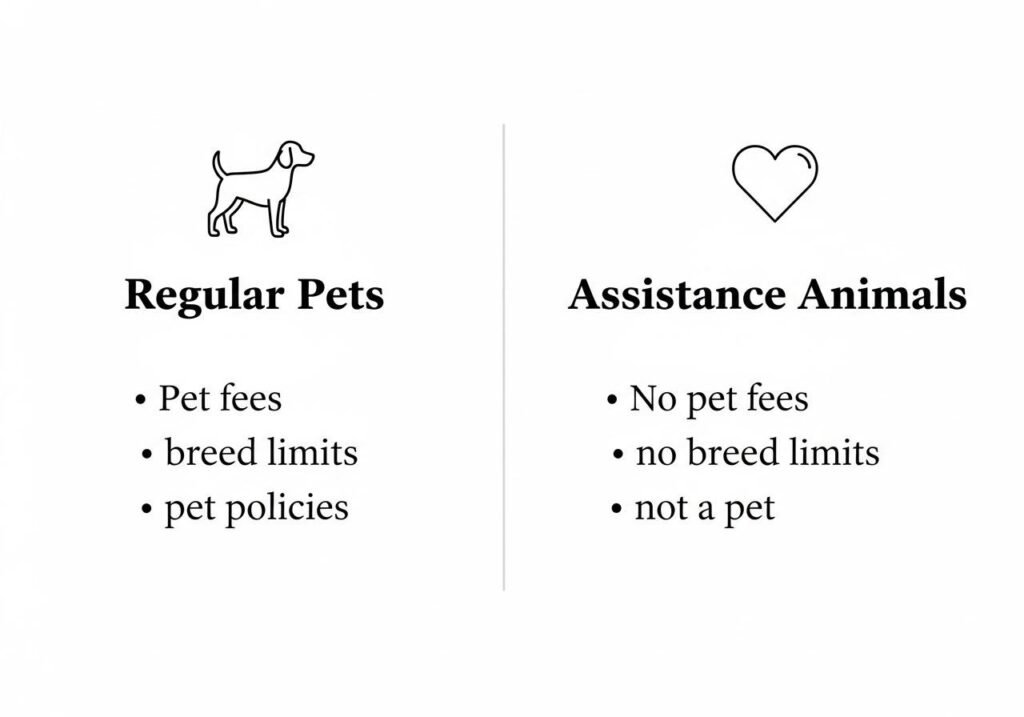
Regular Pets vs Assistance Animals: Key Differences
The rules for pets and assistance animals differ significantly. Assistance animals are not considered pets under the law.
FHA (Fair Housing Act) vs ADA (Americans with Disabilities Act)
The FHA covers service animals trained for specific tasks and emotional support animals which require no specific training.
The ADA applies to public places. This is more limited in scope, and only recognises trained dogs and, in some cases.
Property owners must follow FHA rules for housing, which are broader than ADA rules.
When Property Owners Can Deny
A property owner can deny a request for an assistance animal in some cases.
- It creates a financial burden.
- The specific animal poses a direct threat to the health and safety of others, based on actual conduct, not breed.
- The animal causes substantial physical damage that cannot be recovered.
How to Create a Winning Pet Resume
Basic Pet Information
- Pet name, Pet breed,Pet age, and spay status
- Positive attributes such as friendly, quiet, and well-trained
- Microchip registration details and your local pet licence
Health Records
- Updated and verified vaccination records
- Full health history of your pet with veterinarian contact information
- Health certificates
Training & Behaviour
- Previous behaviour history
- Additional training certificates
- Commands your pet knows, with descriptions
Rental History & References
- A list of previous properties where your pet lived with you
- Reference letters from previous property owners confirming no damages and no complaints
- References from previous neighbours can also be beneficial
Common Challenges During Pet Screening
1. Aggressive behaviour can be a concern for landlords, other tenants, and neighbouring pets.
Solution: Arrange extra training sessions to encourage friendly behaviour and improve your pet’s behaviour before screening.
2. Some insurance policies restrict certain breeds, imposing limits based on perceived excellence in breed behaviour.
Solution: As a tenant you’ve to research local laws and review insurance policies regarding breed restrictions before applying for a rental property.
3. Missing vaccination records can be a challenge for screening, as they are a primary requirement to confirm your pet’s health through managing all vaccination. Incomplete records can raise red flags for landlords and neighbours.
Solution: Pet owners should keep all vaccination records regularly updated, as missing history can result in rejection. Ensure your pet is vaccinated by a licensed veterinarian to maintain complete records.
Information About Spot Pet Insurance
Conclusion
In this article, we have discussed the pet screening process, its challenges, and how to create an online profile for your pet. We have also shared tips to improve your pet resume and avoid rejection from landlords. By following the guidance in this article, you can save time and money, while gaining awareness of important policies relating to pets and assistance animals.